Posts

The Family Bible of Thomas Edwards of Greenville County, South Carolina
Image
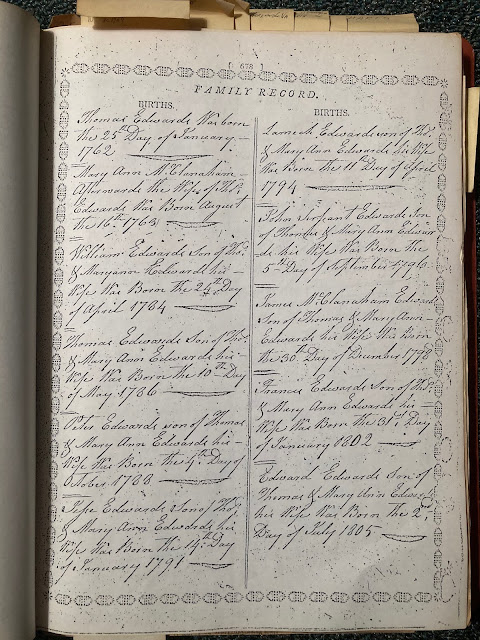
I found an absolute gold mine on eBay last week. A Mrs. Dan Hugh Williamson who evidently died in 2009 had done extensive work on the genealogy of Thomas Edwards and Mary Ann McClanahan of Greenville County, South Carolina some decades ago and compiled her research into a single, slightly musty volume titled THOMAS EDWARDS: Westmoreland Co., Virginia to Greenville Co., SC and after coming across it incidentally I managed to buy it. Mrs. Williamson has done some stellar genealogical work, and has even included photocopies straight from the Thomas Edwards family bible. I've transcribed all of the names and dates in the bible here: Thomas Edwards b. Jan. 25, 1762 d. Aug. 7, 1832 Mary Ann McClanahan, his wife b. Aug. 16, 1763 d. Nov. 14, 1841 Thomas and Mary Ann his wife were married Aug. 27, 1782. Their children: 1. William Edwards born Apr. 24, 1784 d. Feb. 10, 1804 2. Thomas Edwards Jr. b. May 10, 1786 d. July 4, 1843. "Was shot on the public road." 3. Peter Edwards b. O...

Genealogy and Cognitive Bias

When i think about people with hobbies like playing baseball, collecting coins, needlework, or even video gaming, I tend to think most people who spend some time on these things tend to be pretty good at it. After all, how long can you be awful at baseball before your teammates kick you out? For some reason, there don't seem to be any barriers for bad genealogists. The vast majority doing "research" online seem to simply be name collectors, content to pull together the research of others without checking their work and adding them to their own trees (bad enough) or publicly editable trees (even worse). Most seem to be extremely passive about their research, which is fine. But there are those who defiantly post old, badly supported theories continuously without doing a scrap of work themselves. I've found when I actually talk to the folks who are doing this, there are a couple of evident cognitive biases at work: Anchoring bias : when genealogists consider the first th...

The Descendants of Meredith Edwards of Westmoreland County, Virginia

I finally wrote a book compiling the research I've done on this family since January 2019. You can find uploaded at archive.org. Click here to go directly to it: The Descendants of Meredith Edwards of Westmoreland County, Virginia I've compiled all the evidence, sources, citations and research from quite a few different sources, explained why I think the relationships are what they are. Every single thing I've ever found on this family is here, so its 83 pages long. I think there is some historical imperative in getting this family right, since it did produce some fairly noteworthy early Americans, including Senator John Edwards (1748-1834), one of the first elected U.S. senators from Kentucky; his sons, Haden (1771-1849) and Benjamin (1780-1837) Edwards, whose Fredonian Rebellion (1826) sparked the Texas secession movement; Gen. John Edwards King (1757-1828), a military hero from Kentucky who served during the War of 1812; Ninian Edwards (1775-1833), governor of I...

How to Spot a Red Flag in Colonial American Genealogy

I see this stuff over and over again in public trees, posted and re-posted by the thousands. If there's anyone pulling their hair out over these things, here's some red flags to look for that will strongly suggest you're looking at weak research: People in the 17th and 18th centuries with middle names . Yes, some people did have them. But most didn't. Bad genealogists seem to love adding middle names to their colonial ancestors, even if no middle name appears in any record for the individual. Evidently, if they find records of people that are confusing or inconsistent--one guy is named William Smith and another guy from someone else's genealogy with the same wife is named Robert Smith--they will simply add the new first name as a middle name: William Robert Smith. VOILA. Problem solved! People in the 17th and 18th centuries with birth and death dates . This mostly pertains to the colonial south, where parish records are few and far between. ...

William Edwards of Westmoreland Was Not From Surry County, Va.

Image
Having a recent discussion with a professional genealogist, I felt it necessary to make absolutely clear, with careful documentation, that the John, Thomas and William Edwards who appear in Westmoreland, King George and Spotsylvania Counties between 1708 and 1755 are brothers, and the sons of Meredith Edwards (c.1655-1712) of Westmoreland County, Virginia. Given that William Edwards of Westmoreland is the ancestor of several prominent American politicians, including John Edwards (1748-1833), the first elected senator from Kentucky, Haden Edwards (1771-1849), an early Texas revolutionary, and his son, Haden Harrison Edwards (1812-1865), a Texas legislator, there is some historical significance in getting this genealogy right.  A theory that posits that William Edwards of Westmoreland County was the son of William Edwards (c.1680-1722) and Ann Harrison of Surry County has been widely accepted for several decades. This theory evidently originated from the Register of the K...

Identifying Gerrard Edwards of Fauquier County, Virginia

Image
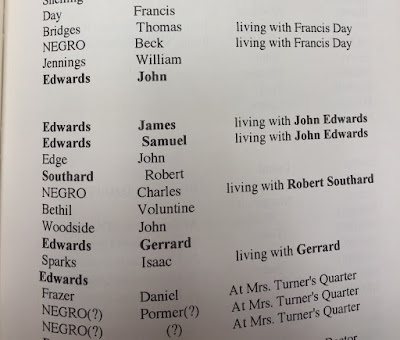
Until very recently, I believed Gerrard (bef.1738 - 1810) and John Edwards (c.1725 - c.1801) of Fauquier County, Virginia were sons of John Edwards Sr. and Jane Arrington. Gerrard's son, Elijah's estate was administered by a "Thompson Edwards" in 1838, and since Ignatius, son of John Sr., had a proven grandson named "Thomson Edwards" in the 1787 tithables of Stafford County, I figured that was enough of a connection. John Edwards of Prince William/Fauquier was called "orphan boy" in an order of 1744, which made sense if his father died in 1743. But alas, I was working with erroneous assumptions. The evidence suggests that Gerrard and John Edwards, though probably related, actually belong to a different family. Firstly, it seems clear these men are likely brothers. Gerrard Edwards appears in the Fauquier County tithables list of June 1759, with John Edwards appearing just four households away. Living with John Edwards are two tithables, James a...

Who was Thomas Nathaniel Edwards?

Image
Many Edwards genealogists digging into the colonial period have come across the name "Thomas Nathaniel Edwards." He is usually said to have born in Wales on October 14, 1690 and died in an unknown location in February or November 1781. Some entries call him "Sir" and say he was from a wealthy family that owned an estate called "Edwards Hall" in Wales. He is said to have been a merchant nobleman (or clergyman) who immigrated to the colonies in the mid 18th century with his wife and children and lived everywhere from New York to Georgia. Descendants claimed he was a loyalist during the Revolution and that his son, Robert Edwards, leased out land in June 1778 that was illegitimately sold to Trinity Episcopal Church in New York City, a lease for which the family was owed money. The resulting "Edwards Fortune" case even ended up in court several times and was dismissed every time. Though these claims were largely debunked, the legend of Thomas N...